Tyres, explained for UK drivers
How to Check Tyre Tread Depth at Home
7 November 2026
You can check tyre tread depth at home in a few minutes with a cheap tread depth gauge, or by looking at the tread wear indicators moulded into the grooves. For a car, the legal minimum is 1.6mm across the central three-quarters of the tread, all the way around the tyre. Here's how to check tyre tread depth at home properly, and what to do with the result.
Quick answer: Measure the main grooves with a tread depth gauge at several points across the central three-quarters of each tyre and around its whole circumference. Anything under 1.6mm is illegal on a car, and if the tread is level with the wear indicator bars, the tyre needs replacing.
Key Takeaways
The legal minimum for cars, light vans and light trailers is 1.6mm across the central three-quarters of the tread and around the entire circumference.
A tread depth gauge is the most reliable way to check at home.
The wear indicator bars in the main grooves show when a tyre is down to the limit.
Check several points on every tyre, because tyres often wear unevenly.
Uneven wear can point to a problem with pressures, brakes, suspension or wheel alignment.
What the law says about tread depth
Cars, light vans and light trailers must have at least 1.6mm of tread across the central three-quarters of the breadth of the tread and around the entire circumference. The outer edges don't count towards the measurement, but the whole of the middle section does.
Driving on tyres below the limit can mean 3 penalty points and a fine of up to £2,500, and that can apply to each illegal tyre. Our guide to UK tyre law sets out the full rules, including cuts, bulges and the MOT.
What you need
A tread depth gauge, sold cheaply by motor factors and online.
A torch, if the light is poor.
A piece of chalk, so you can mark where you started on each tyre.
Park on level ground with the handbrake on. Turning the steering to full lock makes the front tyres much easier to see.
How to check tyre tread depth with a gauge
Push the gauge's probe into one of the main grooves, not a thin slit (sipe) between the blocks.
Press the base flat against the tread blocks either side and read the depth.
Measure in the middle of the tyre and towards each edge of the central three-quarters.
Roll the car forward a little, or ask someone to, and repeat at a few points around the tyre.
Write down the lowest reading for each tyre.
The lowest reading is the one that matters, because the law asks for 1.6mm across the whole central band and around the whole circumference.
Use the tread wear indicators
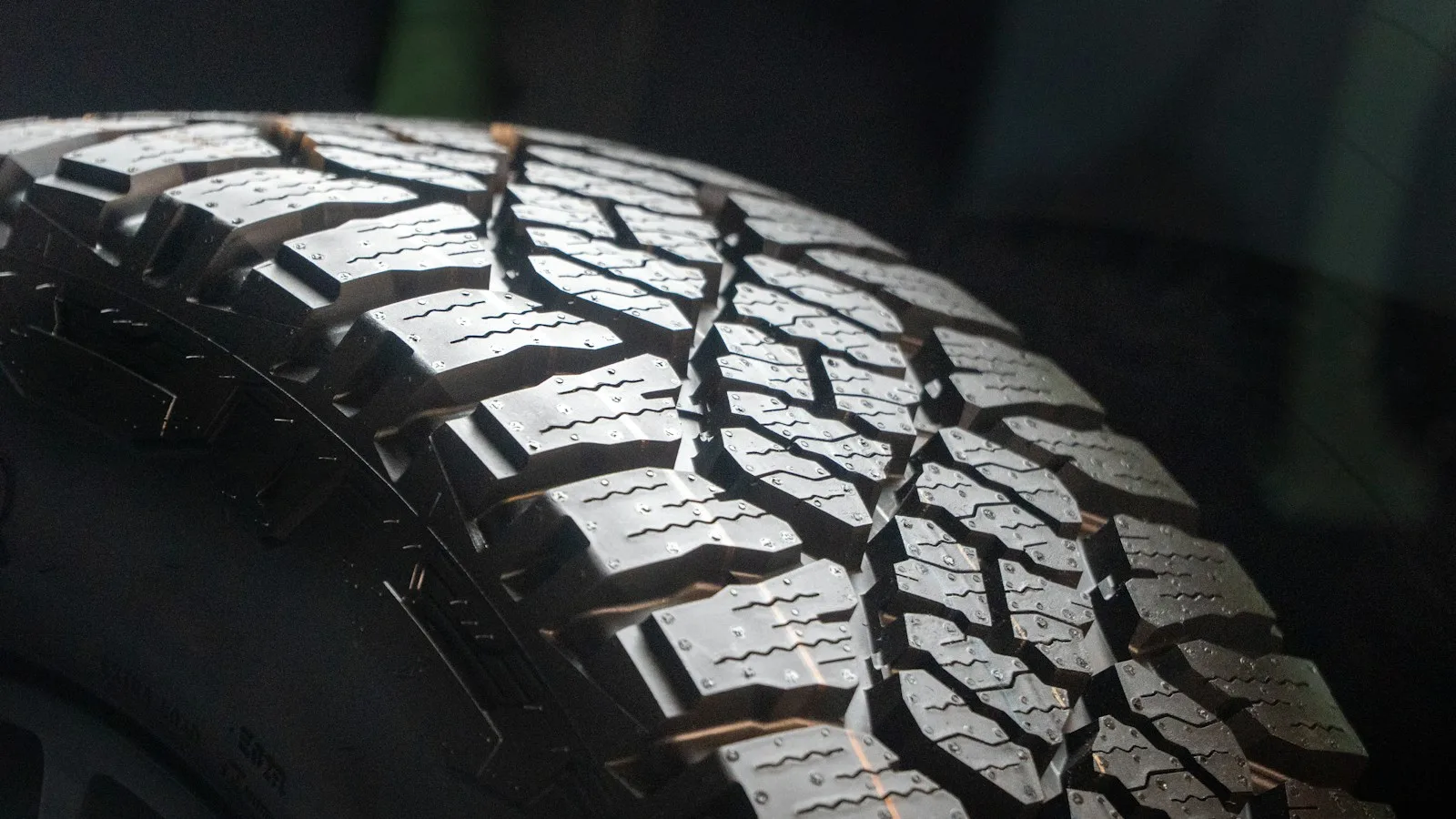
Most car tyres have small raised bars moulded across the bottom of the main grooves. These are the tread wear indicators. When the surface of the tread is level with the bars, the tyre has worn down to the limit and needs replacing.
Look for a small mark on the shoulder of the tyre, often a triangle or the maker's logo, to find where the indicators sit. They're a good visual check between measurements.
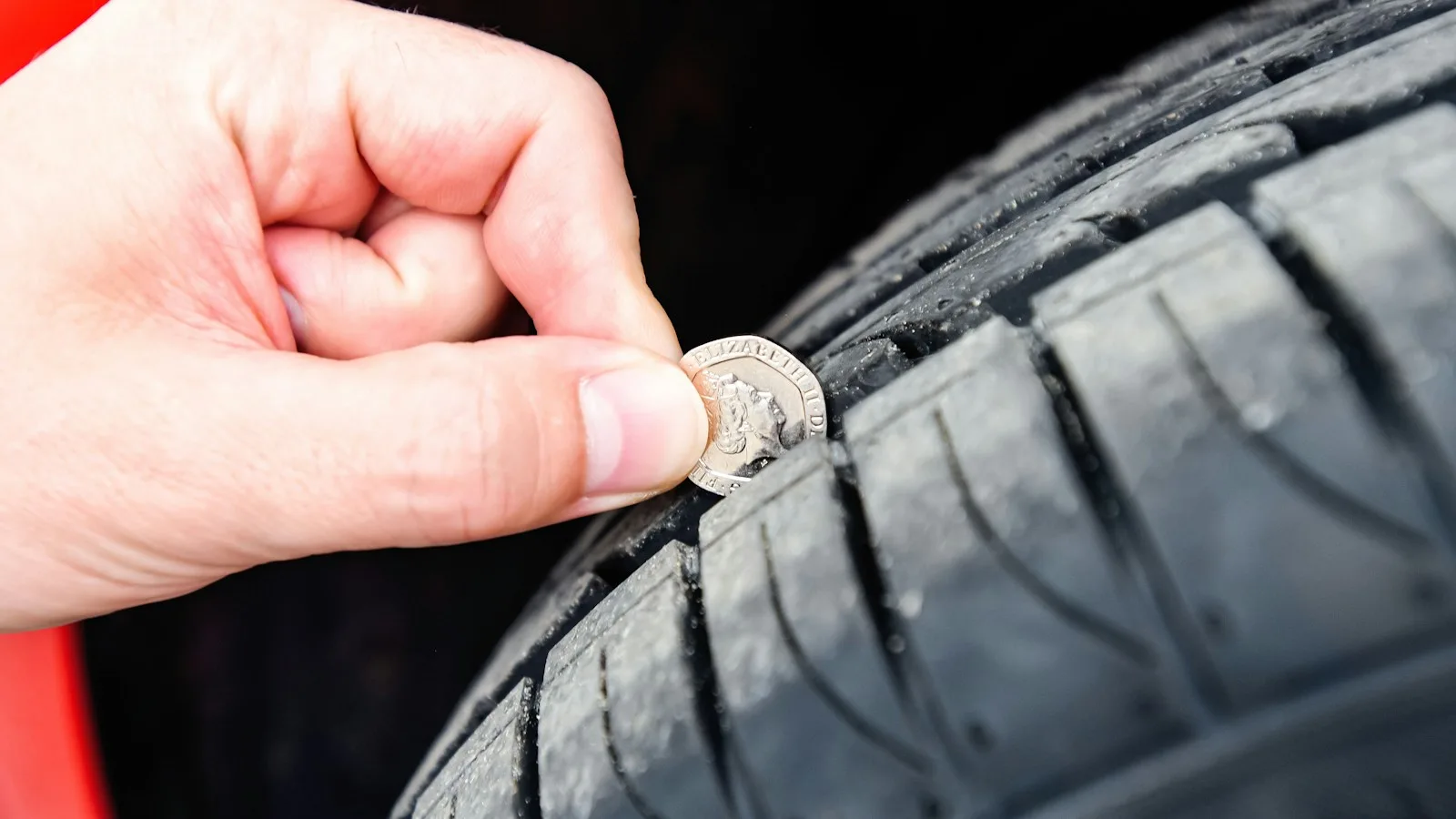
The 20p coin check
Many drivers use a 20p coin as a quick check. Put the coin into the main grooves. If you can see the outer band of the coin, the tread may be close to or below the legal limit, and it's worth measuring properly with a gauge or asking a tyre fitter to check.
It's only a rough guide, so don't rely on it alone.
What uneven wear tells you
Tyres rarely wear perfectly evenly. The Highway Code says excessive or uneven tyre wear may be caused by faults in the braking or suspension systems, or by wheels that are out of alignment, and that these faults should be put right as soon as possible.
What you see | What it can point to |
|---|---|
Worn on both edges, more tread in the middle | Tyre run under-inflated |
Worn in the middle, more tread on the edges | Tyre run over-inflated |
Worn on one edge only | Wheel alignment or suspension problem |
Patchy or scalloped wear | Suspension or balancing problem |
Pressures make a big difference to wear. Our guide to TPMS warning lights explains how to check pressures and what the dashboard light means.
While you're down there, check the condition too
Tread depth isn't the only legal requirement. A tyre also isn't legal with a deep cut of more than 25mm or 10% of the section width, whichever is greater, a lump, bulge or tear, or any of the ply or cord showing.
If you find a nail or screw in the tread, don't pull it out. Our guide to puncture repairs explains when a tyre can be repaired and when it has to be replaced.
How often to check
Check tread depth at least once a month and before a long journey. The Highway Code also asks you to check tyre pressures weekly, when the tyres are cold, so it's easy to do both together.
If a tyre needs replacing, our guide to reading a tyre size helps you buy the right one.
Thinking of a different tyre for the colder months? Our comparison of all-season and winter tyres sets out the options.
What is the legal minimum tread depth in the UK?
For cars, light vans and light trailers it's 1.6mm across the central three-quarters of the breadth of the tread and around the entire circumference. Motorcycles and large vehicles need at least 1mm.
Is a tread depth gauge more accurate than the 20p test?
Yes. A gauge gives you a reading in millimetres, while the 20p test only gives you a rough idea. If the coin test suggests the tread is low, measure it properly.
Will my car fail its MOT on worn tyres?
Yes. Tread depth below the legal requirement is recorded as a dangerous defect in the MOT, so the car fails.
Should I check the spare tyre too?
It's worth it. If you have a full-size spare and it's ever fitted to the car, it has to meet the same rules as the others.
For the official wording, see the vehicle maintenance section of the Highway Code. If any tyre is near the limit, book it in with a tyre fitter rather than waiting for the MOT.